
A 2026 BGES Revolutionary War Field University Program
with Dr. Glenn Williams
June 24-28, 2026; from Newark, NY
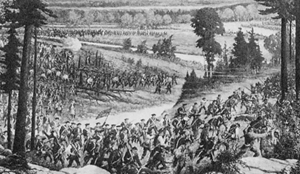
In 1777, Great Britain called on its American Indian allies to enter full participation in the strategy to crush the newly independent United States. British and Provincial regulars, and Loyalist irregulars, joined by warriors of four of the Six Nations of the Iroquois Confederacy that were hostile to the United States—including the Mohawk, Onondaga, Cayuga, and Seneca—as well as the tribes under their dominion, in a brutal terror campaign against American frontier communities—and also those of the pro-United States Iroquois members, i.e., the Oneida and Tuscarora nations. Among other locales, such attacks destroyed homes, villages, and farms, and killed, captured, and left American civilian men, women, and children without food and shelter.
In response, General George Washington ordered detachments of the Continental Army to conduct a campaign of reprisal in 1779 to “scourge,” “chastise,” and otherwise punish those four of the Six Nations “hostile to the United States,” as well as the British organizations that incited and supported their Indian allies to implement the Crown’s military, political, and economic strategies.
This tour, which is the first of its kind presented by BGES, will visit several extant significant sites associated with the Continental Army’s 1779 offensive in western New York State.
Join BGES for this exceptional program as the subject’s leading historian, Dr. Glenn Williams, leads four days of exploration of this often-overlooked campaign – and which the recent Ken Burns documentary got completely wrong – the most detailed study of the Iroquois Campaign offered by any organization.


Itinerary
Wednesday, June 24, 2026 – Orientation (6–7 p.m.)
We’ll gather at the headquarters hotel for an evening orientation with Dr. Williams. He will introduce the campaign, distribute program materials, and set the stage for our field study.
Dinner is on your own.
Thursday, June 25, 2026 (8:00 a.m.–5 p.m.)
The first day will follow the April supporting attack by the expedition commanded by Colonel Goose Van Schaick against the Onondaga in April. The sites we will visit will include Verona Beach, approximately where the Van Schaick Expedition reached Oneida Lake after advancing along Wood Creek from Fort Stanwix (which Americans renamed Fort Schuyler).
We will then move to the extant earthworks of Fort Brewerton—an abandoned French and Indian War post on Oneida Creek near Cicero—where Van Schaick’s troops secured their boats, from which they advanced to attack Onondaga and subsequently returned on their withdrawal.
The bus will then take us to the shore of Onondaga Lake and site of the principal Onondaga town, the expedition’s objective.
Ganondagan State Historical Site is the last stop of Day 1. The museum’s exhibits and a docent will interpret the Seneca experience of the Sullivan Expedition before we tour the authentic reproduction of a traditional Iroquois longhouse – a figurative representation of the traditional homeland of the Haudenosaunee, or Six Nations of the Iroquois Confederacy.
Back to our hotel.
Lunch is included, but dinner is on your own.
Friday, June 26, 2026 (8:00 a.m.–5 p.m.)
On Day 2 we will follow the 1779 offensive’s main effort, the expedition commanded by Major General John Sullivan. Our first stop, Tioga Point–near Athens, Pennsylvania—at the confluence of the Chemung and Susquehanna Rivers. This is the site of Queen Esther’s Town, from which the Provincial Butler’s Rangers and their Iroquois allies began their advance to attack the Wyoming Valley settlements, and which was later destroyed by Colonel Thomas Hartley’s Additional Continental Regiment. Later, Sullivan’s main body advancing here from the Wyoming Valley joined forces with the Brigadier General James Clinton’s Brigade advancing from Cherry Valley, and established Fort Sullivan as a protected forward supply magazine to support the advance into Iroquoia.
The bus will then follow the advance of the Sullivan Expedition, stopping at locations of the events leading up to and including the August 29 battle of Newtown—near Elmira, New York. A highlight will be Newtown Battlefield State Park, which includes a monument to the engagement and offers a spectacular view of the Chemung Valley and the battlefield.
The tour will continue to the site of Queen Catherine’s Town—near present-day Watkins Glen—an Iroquois village at the foot, or southern end, of Seneca Lake, on the way to the site of Canadasaga, the Lower Seneca Castle—near present-day Geneva)—at the head of the lake.
Back to our hotel.
Lunch is included, but dinner is on your own.
Saturday, June 27, 2026 (8:00 a.m.–5 p.m.)
On Day 3 we will continue following the route of the Sullivan Expedition. Stopping first at Canandaigua, where a Seneca town stood the foot, or northern end, of the lake of the same name, we then move to Honeoye Lake, where the army established a fortification to protect a forward supply magazine to leave all but the essential supplies and the cattle, to allow the troops to quicken the to the final objective. The bus will continue to Conesus Lake, where troops erected a bridge that permitted artillery and packhorses to negotiate the morass at the head of the lake.
We then stop at the site of the Groveland Ambuscade, where members of Butler’s Rangers and Seneca warriors waiting in ambush for Sullivan’s advance guard unwittingly ambushed an American reconnaissance patrol led by Lieutenant Thomas Boyd on September 13 instead. There is a monument to the patrol members killed in the action, including Lieutenant Han Yost Thaosagwat, commander of Sullivan’s Oneida scouts. The rangers and warriors captured Boyd and Sergent Michael Parker and took them to Chenussio, the Upper Seneca Castle, the final objective of the expedition. The Crown forces and their allies fled Chenussio, where they ritually tortured and executed their prisoners. Sullivan’s army then destroyed the town and cornfields before marching back to the Mohawk and Susquehanna Valleys.
The site of the “Torture Tree” marks the day’s final stop.
Return to the hotel by 5 p.m.
Lunch is included, but dinner is on your own.
Sunday, June 28, 2016 (8:00 a.m.–5 p.m.)
On the final day we will travel to Youngstown, New York, and visit Old Fort Niagara. This important military installation at the mouth of the Niagara River on Lake Ontario represented the center of British political, diplomatic, and military power in the Northen Theater of War. The post also served as the headquarters of the British regulars of the 8th (“King’s”) Regiment of Foot and the Provincial regulars of Butler’s Rangers—whose barracks were across the Niagara River at the present town of Niagara-on-the-Lake, Ontario. In addition, the British Indian Department operated from the fort as it provided diplomatic and economic relations with the king’s Iroquoian allies, provided them supplies and ammunition, and coordinated their military activities with Crown forces. Because of these roles, several historians are of the opinion that Fort Niagara was the primary objective of General Sullivan’s expedition, and therefore the mission ended in failure. This stop will explain why this is a faulty interpretation of General Washington’s orders and instructions to Sullivan. The tour will conclude with an explanation of 18th century fortifications and siege warfare as we explore the grounds, which will further illustrate that capturing Fort Niagara was not an objective for the Continental Army’s Iroquois Campaign of 1779.
About the Faculty

Glenn F. Williams is a retired Army officer who entered public history as a second career. He recently retired from federal civilian service as a Senior Historian at the U.S. Army Center of Military History, Fort McNair, DC, where he facilitated staff ride exercises at historic battlefields for military units, developed and posted This Day in Army History features on CMH’s social media platforms, and served as project officer for the Army 250th Birthday and Semiquincenttial of the Revolutionary War commemorations. He is the author or co-author of the introductory monograph in the Campaigns of the Revolutionary War series: Opening Shots in the Colonies 1775-1776, released in 2024. His other positions at CMH included Historian of the National Museum of the U.S. Army and Historian / Operations Officer of the Army Lewis and Clark Bicentennial Commemoration. Glenn also served as Historian of the American Battlefield Protection Program of the National Park Service, Curator / Historian of the USS Constellation Museum, and Assistant Curator of the Baltimore Civil War Museum – President Street Station. Outside of CMH, he is the author of several books, including Year of the Hangman: George Washington’s Campaign Against the Iroquois (Westholme 2005), recipient of the Thomas J. Fleming Award for the Outstanding Revolutionary War Book of 2005 and named among “The 100 Best American Revolution Books of All Time” by the Journal of the American Revolution in the spring 2017 issue. His book Dunmore’s War: The Last Conflict of America’s Colonial Era (Westholme 2017) earned Glenn recognition for contributions to the study of 18th Century American military history with the Shelby Cullom Davis Award of the Ohio Society of Colonial Wars and the Judge Robert K. Woltz Award of the French and Indian War Foundation. In addition, Glenn is the author of several journal and magazine articles, a contributor to Battles of the Revolutionary War and War of 1812: Two Interpretive Maps (National Geographic 2012), and the essay “Let It Begin Here: the battle of Lexington and Concord” in The 10 Key Campaigns of the American Revolution (Regnery History 2020). In retirement he continues to research and author books, present lectures, advise filmmakers, and lead staff rides for military units and tours of battlefields and historic sites for general audiences. He holds a B.S. in History from Loyola University of Maryland, a M.A. in History and Certificate in Public History from University of Maryland Baltimore County, and a Ph.D. in History from the University of Maryland, College Park.
Hotel Information
This program will be headquartered at the Microtel Newark, NY, 434 E. Union Street, Newark, NY 14513 (315-879-6990). The BGES special hotel rate is $129 plus tax, with a rate cutoff date of May 24, 2026. When you call the hotel, be sure to tell them that you are booking your room with the group “Blue and Gray Education” to get the special rate.
Thank you for confirming your Group block! Below you will find booking instructions. Please follow the link below to book the Blue and Gray Education rate.
Hotel: Microtel Inn & Suites by Wyndham Newark NY
Group Name: Blue and Gray Education
Arrival Date: Wednesday, 24 June 2026
Departure Date: Sunday, 28 June 2026
Cutoff Date: Sunday, May 24, 2026
Booking Link:
Transportation
The servicing airport is Frederick Duglass Greater Rochester International Airport, Rochester, NY. It is 47 miles from Microtel Newark, NY. Another option is Syracuse Hancock International Airport (SYR). It is 60 miles from Microtel Newark, NY. The hotel does not provide a shuttle. It will require a rental car, Uber, or taxi to reach the hotel.
Recommended Reading
You will receive maps and a notebook that will meet your onsite requirements. The following articles and books are suggested to enhance your readiness for the program. These sources are available online for viewing (articles) or purchase (books):
- Year of the Hangman: George Washington’s Campaign Against the Iroquois, by Glenn Williams
- A Well-Executed Failure: The Sullivan Expedition Against the Iroquois, July-September 1779, by Joseph Fischer
Tour Pricing
Current BGES member $975 (one-time payment, no deposit)
Non-BGES member $1025 (one-time payment, no deposit)
Deposit to reserve spot: $150
Annual membership fee: $75
Registration
To register by mail or fax, download: Printable Registration Form
Questions? Need more information? Please Contact Us