
A BGES Field University Program
With Greg Mertz
October 29 – November 2, 2025; from Fredericksburg, VA
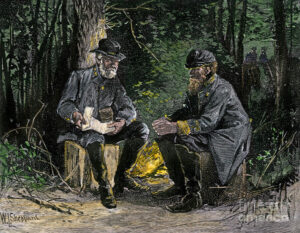 Widely considered Gen. Robert E. Lee’s greatest military victory, the Battle of Chancellorsville is also one of the Civil War’s most complex and paradoxical engagements. Facing an enemy twice his size, Lee—alongside his trusted subordinate, Lt. Gen. Thomas J. “Stonewall” Jackson—executed a bold and risky flanking maneuver that remains a case study in military strategy. The result was a decisive Confederate victory over the numerically superior Union Army of the Potomac, led by the newly appointed and overly confident Maj. Gen. Joseph Hooker. But the victory came at a steep cost: the mortal wounding of Jackson by friendly fire.
Following the Union’s demoralizing defeat at Fredericksburg in December 1862, and a failed winter campaign shortly after, President Abraham Lincoln replaced Maj. Gen. Ambrose Burnside with Hooker. The 48-year-old Massachusetts native, already dubbed “Fighting Joe” by the press, confidently declared he could whip “Bobby Lee!” Under his energetic leadership, the Army of the Potomac was transformed into tip-top condition he described as “the finest army on the planet.”
Hooker orchestrated a “perfect” plan in his mind to confront Lee and drive him from the Confederate stronghold at Fredericksburg. But significantly outmanned, Lee did not retreat. Instead, he met Hooker’s challenge head on, engaging him in one of the bloodiest battles of the Civil War. Brilliant tactics by Lee and “Stonewall” Jackson thwarted Hooker’s ambitions and resulted in a victory for the South. The victory propelled Lee into Pennsylvania, setting the stage for Gettysburg.
Supporting the main action at Chancellorsville were a series of critical engagements in and around Fredericksburg—at Salem Church, Bank’s Ford, and along cavalry lines that stretched across the countryside. These battles played vital roles in the campaign’s outcome.
Still, Lee’s tactical genius could not offset the significant loss in manpower and leadership for Lee and the Confederate Army of Northern Virginia. While Lee’s soldiers inflicted some Union 17,000 casualties, he lost 13,000 men and a significant number of officers—including the irreplaceable Jackson. For Lee, the cost of victory would reverberate for the rest of the war.
BGES is proud to bring to you the renowned NPS Ranger and historian Greg Mertz to lead us in an in-depth, four-day study of the entire Chancellorsville Campaign. From the Federal winter encampment to the Rappahannock crossings, from cavalry movements to rear-guard actions, and through a deep-dive, two-day study of Chancellorsville down to brigade and unit level—we’ll explore every facet of this pivotal campaign. We’ll conclude our journey with a visit to the solemn Guinea Station, where Jackson breathed his last.
Join us this fall for what promises to be an incredible field study of the important Battle and Campaign of Chancellorsville with the incomparable Greg Mertz!
Itinerary
Wednesday, October 29, 2025
Meet at the headquarters hotel at 6 p.m. to receive nametags and program packets. Greg Mertz will deliver an introduction and overview of the campaign, followed by a Q&A. This session will establish the strategic context for the Chancellorsville Campaign. Even though we will be devoting four full days in the field, the expansive nature of the Federal cavalry raid led by George Stoneman means we’ll only be able to cover the initial phase. As such, a key focus of our discussion will be an in-depth exploration of this controversial and far-reaching element of the campaign.
Dinner is on your own.
Thursday, October 30, 2025
Day 1: Preliminary Aspects of the Campaign, and the Federal Turning Movement
Departing the hotel at 8 a.m., we begin the day at the only preserved and interpreted site associated with the Federal Winter Encampment. Many have argued that the winter encampment of 1862-1863 was to the Federal Army of the Potomac what the winter at Valley Forge was to George Washington’s Revolutionary War army. We will examine the transformations introduced by Gen. Joseph Hooker, and his contributions to the army, including key improvements to organization, morale, and especially the cavalry arm.
Hooker’s reforms included the establishment of a dedicated cavalry corps. We’ll explore the early actions of this new formation at Hartwood Church on February 25, 1863, and at Kelly’s Ford on March 17, 1863. From there, we follow the Federal movements through Culpeper County toward the Chancellorsville crossroads in April 1863.
At Brandy Station, we’ll stop at the Graffiti House to study an inscription left by a Confederate cavalryman noting the “Yanks caught hell” during what became an aborted initial attempt by the Union army to launch the campaign on April 14-15, 1863. That first crossing of the Rappahannock was thwarted by torrential rain, hail, and vigilant Confederate cavalry.
It wasn’t until April 28, 1863, that the Federal army resumed its crossing efforts. We’ll visit Fleetwood Hill and Madden’s Tavern while considering how Confederate cavalry commander J.E.B. Stuart misread the Union’s intentions early in the campaign—a costly misjudgment
We’ll trace the campaign’s first shots at Germanna Ford and the Bullock Farm, before concluding the day at the Chancellorsville crossroads. Here, we’ll assess the significance of the meeting between Union generals George G. Meade and Henry W. Slocum, as their columns converged and the campaign entered its next phase.
We will return to the hotel by 5 p.m.
Lunch is provided, but dinner is on your own.
Friday, October 31, 2025
Day 2 – The Battle of Chancellorsville: May 1-2, 1863
This will be our first of two days devoted to exploring the Chancellorsville battlefield, with this day focusing on the fighting—and the decisions—made on May 1 and 2, 1863. Leaving the hotel at 8 a.m., we begin at Zoan Church ridge, where Confederate Gen. Thomas J. “Stonewall” Jackson made one of the battle’s critical decisions. He chose not to fight defensively in those works, but to boldly advance and take the offensive.
We will visit the Chancellorsville Day One battlefield, where Union Gen. George Sykes confronted Jackson until realizing he was being flanked. Sykes withdrew to a much stronger position—one you’ll examine firsthand—but General Hooker, without ever seeing the ground, ordered the line abandoned to the dismay of his subordinates.
At the Lee-Jackson bivouac, we’ll explore the remarkable collaboration between these two commanders, with different ideas, as they devised what would become one of the most audacious flank attacks in military history. A stop at Catherine Iron Furnace offers insight into how Jackson’s movements were perceived by Federal observers—and nearly altered the battle’s trajectory.
We will then follow Jackson’s legendary flank march, reviewing his final decisions and Federal attempts to interpret the movement unfolding in the Wilderness. Multiple stops will highlight the intense May 2 fighting, culminating in Jackson’s attack.
The day will wrap up with the tragic events of Jackson’s evening reconnaissance and wounding, followed by a visit to Ely’s Ford, where J.E.B. Stuart was summoned to take over Jackson’s command.
We will return to the hotel by 5 p.m.
Lunch is provided, but dinner is on your own.
Saturday November 1, 2025
Day 3 – The Battle of Chancellorsville: May 3, 1863
At the time, Chancellorsville was the bloodiest battle of the Civil War, largely because of the brutal combat on May 3, 1863. During a five-hour period that morning, it’s estimated that a casualty occurred every second. While it is difficult to estimate the number of casualties for individual days of multiple day battles like Chancellorsville, it is widely believed by many that May 3, 1863, was the second bloodiest day of the entire Civil War, exceeded only by the September 17, 1862, losses at Antietam.
We’ll examine the strategic choices open to both armies and dissect the execution of three Confederate division-sized attacks. We cover all three waves of the Confederate division-size attacks. Prominent landmarks including Hazel Grove, Fairview, and the Chancellorsville Inn will be seen, as well as several lesser-known features on the north side of the Orange Turnpike.
We’ll also stop at more obscure yet significant places, including the Central Virginia Battlefield Trust site near where the 27th Connecticut was captured. Our day will conclude with a discussion of Hooker’s injuries, his controversial decision not to relinquish command, the subsequent council of war, and the Union retreat across the Rappahannock.
We will be back at the hotel by 5 p.m.
Lunch is included, but dinner is on your own.
Sunday November 2, 2025
Day 4 – The Battle of Second Fredericksburg and Salem Church: May 3, 1863; the Battle of Salem Heights: May 4, 1863; and the Death of Thomas J. “Stonewall” Jackson
Often overshadowed in histories of the Chancellorsville Campaign, the actions east of the main battlefield were deeply entwined with Lee’s overall operations. From the Federal perspective, the Second Battle of Fredericksburg on May 3, where Union Gen. John Sedgwick fought over some of the same terrain that witnessed the most lopsided Federal engagement of the war some five months earlier, was their sole tactical success in the campaign.
Leaving the hotel at 8:30 a.m., we will walk over the same ground of the more famous battle, only considering the terrain from a different point of view than usual as we look at the almost forgotten second battle.
Later today, we turn to events at Salem Church. There, Confederate Gen. Cadmus Wilcox mounted a bold stand, reinforced by Lee himself, who diverted troops from his already outnumbered Chancellorsville forces. The small brick church is an oasis of preservation in the midst of heavy traffic and development.
While Chancellorsville is often called “Lee’s Greatest Victory,” Lee himself would not have made such a declaration. Lee felt that his best opportunity of the campaign was to destroy Sedgwick’s isolated corps during the May 4, 1863, battle of Salem Heights, and he was sorely disappointed when he was unable to coordinate a decisive blow. We’ll visit what is called the Smith Run battlefield, where Louisiana and Vermont troops clashed in this critical but often-overlooked battle.
Our four-day tour concludes with a visit to the Jackson Death Site at Guinea Station, followed by a discussion of the personal and military ramifications of Jackson’s loss.
About the Faculty
 Greg Mertz spent a 40-year career working as a historian and interpreter with the National Park Service in Gettysburg, Pennsylvania, and Fredericksburg, Virginia. He has authored the book Attack Them at Daylight and Whip Them: The Battle of Shiloh, April 6-7, 1862. In retirement, Greg conducts tours for Battlefield Tours of Virginia, and serves on the boards of Friends of Wilderness Battlefield, the Brandy Station Foundation, and the Rappahannock Valley Civil War Round Table.
Hotel Information
The headquarters hotel is the Townplace Inn, 4700 SR-1489, Fredericksburg, VA 22408. Call 540-891-0775 for reservations. Ask for the Blue and Gray Education block. The rate is $114 plus tax. The cutoff date for the block rate is September 29, 2025.
Transportation
The servicing airports are Richmond International Airport (RIC), 59 miles via I-295 and I-95 North, or Ronald Reagan National Airport (DCA), 57 miles via I-395 and I-95 South.
Suggested Reading List
- Bigelow, John. The Campaign of Chancellorsville: A Strategic and Tactical Study (with Maps and Plans). New Haven, CT: Yale University Press: 1910. ASIN: B00NIZZEL4.
- Furgurson, Ernest B. Chancellorsville 1863: The Souls of the Brave. New York NY: Alfred A. Knopf, Inc., 1992. ISBN: 978-0679728313.
- Mackowski, Chris, and Kristopher D. White. Chancellorsville’s Forgotten Front, The Battles of Second Fredericksburg and Salem Church, May 3, 1863. El Dorado Hills, CA: Savas Beatie,
LLC, 2013. ISBN: 978-1611211375. - Sears, Stephen W. Chancellorsville. New York, NY: Houghton Mifflin Company, New York, NY,
1996. ISBN: 978-0547525853.
Registration
To register by mail or fax, download this printable registration form: The Chancellorsville Campaign.
Questions? Need more information? Please contact us.