
A BGES Civil War Field University Program
With Hal Litchford
August 26-30, 2026, from Franklin, TN
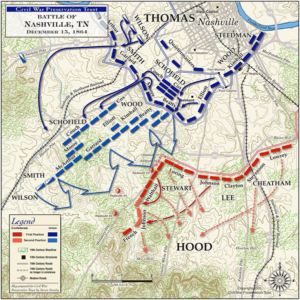
After the disaster at Franklin, General John Bell Hood’s depleted Army of Tennessee advanced on Nashville. Major General Nathan Bedford Forrest’s’ vanguard reached the city on December 2, 1864. From atop Rains Hill, Forrest surveyed the strong fortifications that completely encircled the city. Hood arrived shortly thereafter with his infantry bolstered by Lieutenant General S. D. Lee’s Corps and the army’s artillery, neither of which arrived in time to fight at Franklin. Hood’s apparent strategy was Franklin in reverse – he wanted to entice Thomas to assault strong defensive works. Hood established a defensive line that only covered approximately four miles—all he could reasonably cover—because of the losses suffered at Franklin and Spring Hill.
Both flanks were essentially “in the air,” meaning that each side of Hood’s defenses was vulnerable to an attack. The first line was anchored on the right by a lunette that overlooked a deep railroad cut. The open area between the lunette and the Cumberland River east of Nashville was covered by rebel cavalry. On the Confederate left, Hood’s engineers laid out and partially constructed five redoubts on strategic points of high ground. Confederate cavalry was again assigned to protect the two miles between the left flank and the Cumberland River west of the city. The center of the original line included Montgomery Hill, but this position was too vulnerable to Union artillery and sharp shooters. Hood subsequently realigned this section of his first line.
In Nashville, Major General George Thomas dealt with a myriad of logistical problems. He was still consolidating and organizing the men under his command that had been scattered throughout Tennessee, Alabama and Georgia, as well as three divisions from Missouri under the command of Major General General A.J. Smith, a problem that the “Rock of Chickamauga” had been facing for the past two months. Thomas anticipated the arrival of a provisional detachment of two divisions under the command Major General James B Steedman which included the unseasoned First and Second Colored Brigades.
Most of the cavalry, now under the command of Major General James H Wilson, required remounting and refitting after their recent hard campaign of shadowing the Confederate Army of Tennessee from the Tennessee River. The demand for remounts was so urgent that Wilson impressed the horse of Tennessee’s Military Governor, Andrew Johnson, as well as some “performing horses” from a circus that was in the State Capital at the time. Thomas was also beset by constant exhortations from Grant, Halleck, and even Lincoln, to take the offensive against Hood. In the first two weeks of December, there were 26 communications to Thomas either insisting on immediate action or criticizing him for not acting soon enough. Thomas steadfastly refused to attack Hood until his army was ready and the weather was suitable.
As the Confederates entrenched and awaited events, Hood made two strategic moves. He ordered Forrest and two of his three cavalry Divisions to Murfreesboro to reinforce Bate, whose division had been diverted there after the Battle of Franklin. Second, Hood dispatched Brigadier General Hylan B. Lyon’s 800-man Kentucky cavalry brigade on a raid through that Commonwealth. After a demoralizing defeat before Fortress Rosecrans north of Murfreesboro, Bate’s battered Division returned to the main army in Nashville. Hood, however, ordered Forrest to remain in the Murfreesboro area to continue to impede reinforcements from reaching Nashville. As a result, two Divisions of Forrest’s cavalry and Forrest himself would be unavailable for the upcoming battle.
On December 14, a thaw melted the ice from an extreme ice storm that had hit Nashville almost a week earlier. The next day, December 15, Thomas’s men emerged from the Union works to give battle. His battle plan was to make a strong demonstration against the Confederate right to hold the troops there in place while the main assault was conducted against the Confederate left and center. The demonstration against the Confederate right was assigned to General Steedman who deployed the Colored Brigades as the tip of the spear. Thomas’s plan was well executed. Although the Confederates held their ground on the right, Thomas’s main thrust was successful. By superior numbers, Thomas’s men swept around and behind the Confederate left. The Confederates were forced back two to three miles as darkness descended.
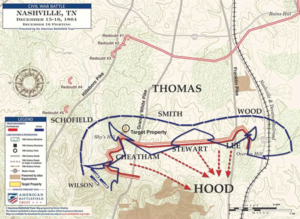
Overnight, Hood reorganized a contracted line at the base of the Overton/Brentwood Hills. The following day (December 16), Thomas renewed his attack. His superiority in numbers caused a collapse of the Confederate left anchored on Compton’s (thereafter Shy’s) Hill. A chaotic rush to the rear by the Confederate soldiers ensued. Desperate but effective stands by S. D. Lee’s men on the Franklin Turnpike and by Colonel Edmund W. Rucker’s cavalry on the Granny White Pike provided enough time to enable the escape of what was left of the Southern Army of Tennessee.
The thoroughly demoralized Army of Tennessee slowly retreated to the Tennessee River in awful weather conditions and under relentless pursuit by Union forces. By virtue of brilliant rear-guard tactics, the remnants of Hood’s Army safely reached and crossed the Tennessee River at Bainbridge by December 29.
Join Hal as we examine the events and, more importantly, the ground where the Battle of Nashville, Lyon’s Raid, and the Army of Tennessee’s retreat occurred.


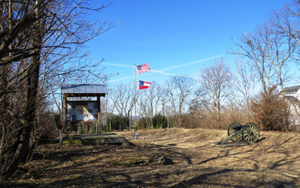

Confederate position at Nashville
Itinerary
Wednesday evening, August 26, 2026, 6:00-7:00 PM: Orientation
Meet at the headquarters hotel at 6 p.m. to receive nametags and program packets and meet our historian. Hal will deliver an introduction to the program including an overview of the Fall 1864 Tennessee Campaign: including the objectives of each side. Here, your program materials will be handed out (or the next morning if you are late arrival).
Dinner is on your own.
Thursday, August 27, 2026, 8:00 AM-5:00 PM:
8:00 Depart Hotel
Day 1: Lyon’s Raid
Today, we will visit sites associated with Lyon’s Kentucky Raid. This little-known raid was not lacking in drama and interesting angles. It featured a suicide bomber, the disappearance of a federal payroll chest, the return of General Lyon’s recently kidnapped wife and another tour of duty for Forrest’s “Hoss Marines.” Along the way Lyon, himself a Kentuckian, burned eight county court houses.
The raid was the brainchild of General Hood. When Forrest left West Tennessee on Hood’s orders in early November 1864, he left behind Lyon’s Kentucky Brigade. As Hood started north from Florence, he ordered Lyon to enter Kentucky for the primary purpose of supporting the anticipated movement beyond Nashville. Specifically, Lyon was to seize grist mills, put them in running order, and put them to grinding at once. Secondarily, Lyon was directed to destroy the L&N Railroad between Nashville and Bowling Green and to disrupt telegraph infrastructures. Lyon was also tasked with capturing Clarksville if feasible. In addition to logistical support, Hood’s intent was for Lyon to operate in the Union rear, thereby enabling more aggressive Confederate maneuvering in Tennessee. Implicit in Lyon’s orders was the strategic goal of weakening Thomas by causing him to detach men to Kentucky.
Lyon’s troopers left Paris, Tennessee, on December 6 and crossed the Cumberland River at Cumberland City, Tennessee, on December 9. Cumberland City lies between Fort Donelson and Clarksville. There, he commandeered vessels to transport his men, horses, supplies and two howitzers to the north bank. Lyon again utilized the riverine experience of one of his cavalry captains, Frank Gracey, to pilot the captured transports. (Just weeks before, Captain Gracey had piloted the captured Union gunboat Undine during Forrest’s operations against Johnsonville). Lyon destroyed vessels, supplies and public property valued at $1 million. Clarksville was protected by the formidable Fort Defiance, and no attempt was made to capture it. Lyon reached Hopkinsville, Kentucky, on December 11, prompting the Union garrison to abandon the town. Ostensibly because the courthouse had been used to billet Union garrison soldiers (conspicuously including USCTs) and/or as a prison for Confederate sympathizers, Lyon proceeded to burn it. He permitted citizens to remove county records beforehand, however, a practice he followed as he burned another seven courthouses during the raid. Lyon then divided his force. He led one of his two brigades to his hometown of Eddyville on the east bank of the Tennessee River. There was no apparent military value for this excursion, but it did enable Lyon to visit his wife and young son.
Thomas, under increasing pressure from Grant and Halleck to proactively move against Hood and hampered by his dearth of effective cavalry, nevertheless dispatched two of the three brigades of Brigadier General Edward M. McCook’s Division that had just arrived in Nashville as reinforcements. When he reached Hopkinsville on December 16, McCook attacked Lyon’s remaining brigade. The ensuing sharp engagement routed the Confederates. Only the fortuitous arrival of Lyon and his other brigade, coupled with tactical blunders by the Federals, prevented the destruction or entrapment of Lyon’s command. McCook remained at Hopkinsville with one brigade and sent the other brigade to pursue Lyon. The pursuit was tepid and, with one exception at Ashbysburg located on the Green River, there were no significant engagements after the Hopkinsville clash.
When Lyon eventually learned of Hood’s defeat at Nashville, he abandoned the raid and retreated south through Tennessee to Alabama. He covered over 400 miles in just 28 days. Ironically, Lyon’s Raid did accomplish the strategic purpose of drawing Union forces away from Nashville. In his post-War autobiography, General Wilson wrote that the detachment of Cook’s brigades so weakened his cavalry corps that it prevented him from delivering the finishing blow to the Army of Tennessee.
We will visit the significant existing sites of Lyon’s Raid as we trace his route to the Green River. Along the way, we will discuss the operational details of this raid and the incidents that occurred. We will also review Lyon’s remarkable retreat and escape, a dramatic and fascinating story in and of itself.
Tonight, Hal will host a “Happy Hour” after dinner to discuss aspects of Lyon’s Raid in more detail, especially those sites that no longer exist or that we were unable to physically visit.
Lunch is included but dinner is on your own.
Friday, August 28, 2026, 8:00 AM-5:00 PM:
8:00 Depart Hotel
Day 2 – The First Day of the Battle of Nashville: December 15, 1864
[This will be our first of two days devoted to exploring the Nashville battle.]
Today, we will spend the entire day taking a deep dive into the first day of the Battle of Nashville with a special emphasis on the role of USCT brigades.
The morning of December 15 dawned with dense fog. That and the muddy conditions caused by the thaw of the ice that covered the area delayed the commencement of Thomas’s attack until noon. The demonstration against the Confederate right and Granbury’s Lunette was assigned to General Steedman who deployed the Colored Brigades to begin the Federal operation.
Their “demonstration” escalated into a series of full-fledged assaults that were vicious and bloody but unsuccessful in the end. The USCT soldiers were mowed down in droves when they were pinned in the railroad cut that was commanded by the lunette. On the Confederate left, Schofield’s and A.J. Smith’s infantry and Wilson’s dismounted cavalry, supported by Union gunboats, combined to flank and penetrate the rear of the Confederate line. After much fierce fighting, the imposing redoubts that anchored the Confederate left were either captured or abandoned.
We will start today where we left off last August — Blockhouse No. 2. This was the site of the first action of USCT soldiers at Nashville. We will then visit what is left of the line that was held by the 1st and 2d Colored Brigades on the Union’s far left. We will trace their “demonstration” movement that ended in the futile and bloody assault of Granbury’s Lunette and the Confederate right. We will stop at the lunette and examine the railroad cut that is both deeper and longer than the famous cut at Gettysburg. After visiting Fort Negley and other strong points of the Union fortification surrounding Nashville, we will visit Confederate Redoubts Nos. 1, 3, and 4, and point out the now fully developed site that was Redoubt No. 5.
Lunch is included but dinner is on your own.
Saturday, August 29, 2026, 8:00 AM-5:00 PM:
8:00 Depart Hotel
Day 3 – The Second Day of the Battle of Nashville: December 16, 1864
Today is dedicated to the decisive second day of the Battle of Nashville. Overnight, Hood withdrew his main lines south roughly two miles and further contracted them. Both flanks were anchored on strong topographical features — Peach Orchard Hill on the right and Shy’s Hill on the left – but there were open areas beyond each one. Lee’s Corps held the Army of Tennessee’s right portion of the line, Lieutenant General A.P. Stewart’s Corps the center and Major General B.F. Cheatham’s Corps the left. Thomas’s battle plan was basically a carbon copy of the first day. Steedman’s Colored Brigades would open with a strong demonstration in force against the Confederate right followed by a massive assault on the center and left by the bulk of Thomas’s force.
Despite their fearsome losses the day before, the same USCT soldiers repeatedly assaulted Lee’s near impregnable position on Peach Orchard Hill. They were mauled by Confederate artillery. Lee held this position throughout the day which proved to be instrumental in enabling the Army of Tennessee’s escape without more catastrophic loss at the end of the day. Relentless Union pressure on the Confederate left, and particularly the movement of Wilson’s dismounted troops around that flank, eventually caused the collapse of the line at Shy’s Hill. The result was a wild scramble by the Confederate soldiers seeking safety beyond the Brentwood Hills. Tenacious fighting by Lee’s soldiers kept the Franklin Pike open for Confederate escape. A desperate stand by Confederate Colonel Edmund Rucker’s cavalry on Granny White Pike at the Barricades near dark prevented the pursuing Federals from cutting off the retreating Army of Tennessee south of Brentwood. By nightfall, Hood’s army was a disorganized mob moving southward, but it was not completely destroyed.
Today, we will again follow the action of the Colored Brigades. Even though General Thomas harbored doubts about their fighting ability, the courage and gallantry displayed by the USCT soldiers at Peach Orchard Hill dispelled all his misgivings. After witnessing their obvious bravery and heavy casualties Thomas observed:” The question is settled; the Negro will fight.”
We will trace the Confederates’ new lines and artillery positions, which are now mostly located in residential yards. We will dissect the action on Shy’s Hill and the reasons for the Confederate collapse. We will traverse the actual route of the fleeing Army of Tennessee soldiers from the Confederate left and center as they made a panicky mad dash to the Franklin Pike and the rebel lifeline. With the benefit of recent scholarship and forensics, we will take a fresh look at the actual location of the action at the Barricades and Rucker’s actual route to the site. And we will follow the initial rearguard stand by Lee’s units as the Army of Tennessee began its long miserable trek back to and across the Tennessee River.
Lunch included but dinner is on your own.
Sunday, August 30, 2026, 8:00 AM-5:00 PM:
8:00 Depart Hotel
Day 4 – Hood’s Retreat
Today, we will follow the path of the Army of Tennessee as it retreated to the Tennessee River and the dogged Federal pursuit. December 17 was a rainy day, and Hood’s army—a disorganized mass—was strung out along the Columbia Pike as it made its way south. General S.D. Lee was in charge of the Rebel rear guard. General Wilson was in command of the Federal pursuit. Although Wilson was supported by infantry, the pursuit was primarily a cavalry affair.
On this day, the Confederate rear guard used every topographically advantageous position to slow and hinder Union pursuit. The Confederates’ first organized stand was at a choke point called Hollow Tree Gap south of Brentwood. Lee organized subsequent effective stands at the Harpeth River at Franklin, and again at Winstead Hill south of Franklin. Lee was wounded at the latter place, and he turned command of the rear guard over to Major General L. Carter Stevenson.
A series of engagements ensued near the end of the day in which the diminishing Confederate rear guard was almost overwhelmed. This action is known as the Battle of the West Harpeth but that was just the location of the final desperate encounter. The Confederates contested Wilson at every ridge between Winstead Hill and the West Harpeth River.
The timely arrival of Confederate reinforcements and artillery narrowly averted disaster at the last stand on the north bank of the West Harpeth. Thereafter, the Confederate retreat was mostly undisturbed until the army reached Columbia on December 18. The pursuing Union forces were unable to cross the Duck River due to high water, destroyed bridges and an error that misdirected the Union pontoon train.
In the evening of December 18, Forrest arrived and ultimately assumed command of the rear guard. He selected Major General Edward C. Walthall to lead an ad hoc assembly of partial infantry brigades to work in conjunction with his cavalry. Altogether, Forrest’s rear guard totaled 2300 infantry and around 3000 effective cavalrymen. Wilson’s cavalry command was roughly twice the size, and his men were armed with Spencer repeating carbines. As Hood led the army south, Forrest’s rear guard remained in Columbia until Union forces crossed the Duck River and resumed the chase on December 23. In the meantime, the frigid and icy weather returned.
On December 24, Forrest’s rear guard made its first hard stand at Richland Creek, some ten miles north of Pulaski. As at the West Harpeth River, this stand was more the culmination of a series of delaying actions at strategic points along the road.
On Christmas Day, Forrest executed a textbook ambush at Anthony’s Hill, seven miles south of Pulaski, that seriously disrupted Wilson’s lead brigade. The surprise attack while the Union lead elements were ascending this steep hill caused so much confusion and delay that the Army of Tennessee was able to move its trailing trains almost beyond reach. Overnight, Forrest marched the rear guard ten miles to the south bank of Sugar Creek.
On December 26, Forrest engineered another classic ambush that effectively ended Wilson’s pursuit. Wilson’s troops were exhausted and suffering from exposure, the horses were broken down, and the supporting infantry was out of range. The remnants of the Army of Tennessee made their way across the Tennessee River at Bainbridge December 26-29.
Today, we will follow in the footsteps of the Confederate rear guard and the Union pursuit. One objective of today’s exploration is to demonstrate that these rear-guard engagements did not occur linearly or discretely. Examination of the terrain and contemporary accounts from soldiers and troopers of both sides clearly indicate that the actions were more a series of clashes with an endpoint. This is best illustrated between Winstead Hill and the West Harpeth and between Columbia and Richland Creek. Our travel today is rewarding because the sites and terrain are so pristine. The old roadbed ascending Anthony’s Hill where Forrest’s men made their headlong charge, is still very much visible and intact. We will visit the cemetery atop Anthony’s Hill where Confederate casualties were buried. In addition, we will be following the exact route Hood and Forrest took from Anthony’s Hill to Sugar Creek and beyond.
As a footnote and for closure, General Thomas deemed the end of the pursuit of Lyon at Red Hill, Alabama, on January 10, 1865, the “last blow” of the Nashville Campaign.
We will be back at the hotel by 5 p.m.
Lunch is included.
About the Faculty

Hal LitchfordA native of Nashville, Tennessee, Hal grew up in the height of the Centennial years of the Civil War which helped to spark and shape his deep interest in the American Civil War. A lawyer specializing in Antitrust Law, Aviation Law, and Business and Intellectual Property Litigation with the Baker Donelson firm in Orlando, Florida, Hal’s attention to detail serves him (and us) well in his study of the battles and events that happened in his native Volunteer State. Hal has provided lectures, tours, and written articles on various subjects centered on the Fall 1864 Tennessee Campaign and other related events, and he is currently working on a book on Hood’s 1864 Tennessee Invasion from Tuscumbia to Columbia. He also serves on the Board of directors for Blue and Gray Education Society.
Hotel Information:
This program will be headquartered at Hampton Inn Franklin Cool Springs, 7141 South Springs Drive, Franklin, TN 37067. Phone: 615-771-7225. The BGES special hotel rate is $132 plus tax, with a rate cut-off date of July 26, 2026. When you call the hotel, be sure to tell them that you are booking your room with the group “Blue and Gray Education” to get the special rate. The hotel does not have an airport shuttle.
Transportation
The servicing airport is Nashville International Airport (BNA), which is 21 miles from the hotel.
Recommended Reading
You will receive maps and materials that will meet your onsite requirements. The following books are suggested to enhance your readiness for the program.
The most valuable resource on the net is the Battle of Nashville Trust website. It has a wealth of information about the battle and the battlefield. The Battle of Nashville Trust.
- Bearss, Edwin C. “The History of Fortress Rosecrans,” Washington, D.C.: National Park Service Department of the Interior Report, 1960 (accessible at fortress-rosecrans-history.pdf ) (Blockhouse No. 2 and Forrest’s operations around Murfreesboro).
- Belcher, Dennis W. The Cavalries of the Nashville Campaign. Jefferson, NC: McFarland & Company, Inc., 2020.
- Chick, Sean Michael, They Only Came Only to Die: The Battle of Nashville December 15-16, 1864. El Dorado Hills, CA: Savas Beatie LLC, 2023.
- Horn, Stanley F., The Decisive Battle of Nashville, Knoxville. TN: The University of Tennessee Press, 1978.
- Smith, Derek, In the Lion’s Mouth: Hood’s Tragic Retreat from Nashville. 1864. Mechanicsburg, PA: Stackpole Books, 2011.
- Scales, John R. The Battles and Campaigns of Confederate General Nathan Bedford Forrest. El Dorado Hills, CA: Savas Beatie LLC, 2017.
- Sword, Wiley. The Confederacy’s Last Hurrah: Spring Hill, Franklin and Nashville. Lawrence, KS: University Press of Kansas, 1993.
Optional Reading:
- Davis, Stephen. Into Tennessee and Failure. Macon, GA: Mercer University Press, 2020.
- Hood, Stephen M. (“Sam”). John Bell Hood: The Rise, Fall and Resurrection of a Confederate General. El Dorado Hills, CA: Savas Beatie, LLC, 2013.
Tour Pricing
Current BGES member: $975 (one-time payment, no deposit)
Non-BGES member: $1025 (one-time payment, no deposit)
Deposit to reserve spot: $150
Annual membership fee: $75
Registration
The registration period for this tour has closed. Please check out some of our other tours that may interest you or contact us to inquire about a future offering for this tour.
To register by mail or fax, download: Printable Registration Form
Questions? Need more information? Please Contact Us