
A BGES Revolutionary War Field University Program
with Dr. Chris Fonvielle Dr. Kim Sherman,
Hunter Ingram, Stacey Jones, and Stephen Atkinson
February 19-20, 2027, from Wilmington, NC
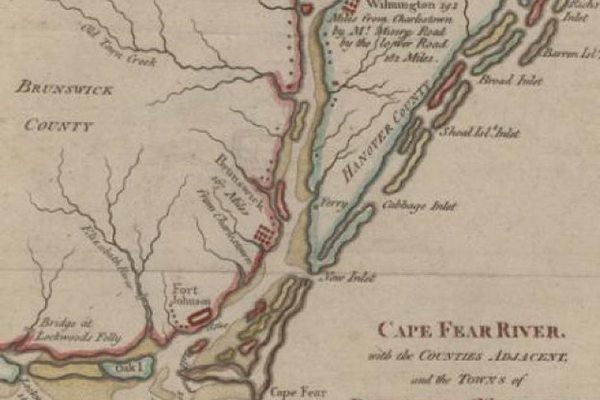
Founded in 1739, Wilmington was North Carolina’s largest city and port during the Revolution, with about 1,200 residents and 200 homes. The city became a center of revolutionary activity, beginning with the Stamp Act Rebellion in 1765, when nearly 500 residents gathered at the county courthouse, hung an effigy of Lord Bute, and burned it in protest of British taxation. Wilmington also helped force the resignation of stamp master William Houston, making North Carolina the only colony that never issued Stamp Act taxes. In 1775, Patriots burned Fort Johnston, the royal stronghold at the mouth of the Cape Fear River, forcing Royal Governor Josiah Martin to flee and signaling the collapse of British authority along the coast. At Moores Creek, one of only two such Revolutionary War sites in North Carolina, Patriot and Loyalist forces fought on February 27, 1776.
In January 1781, British forces under Maj. James Henry Craig occupied Wilmington to establish a supply base for Lord Cornwallis’s campaign in North Carolina. North Carolina militia, led by Col. Henry Young, tried to counter the British at Heron’s Bridge, but the British pursued and harassed them, underscoring the ongoing skirmishes in the region. Although Wilmington saw no major battle, its occupation was strategically significant, supporting Loyalist forces in the interior and threatening Whig control.
Schedule of Events:
Friday, February 19, 2027, 10:00 AM – UTC. Moores Creek National Battlefield Tour by Dr. Chris Fonvielle Jr.
Operated by the National Park Service, join Chris Fonvielle as he leads you on a walking tour of Moores Creek National Battlefield, one of only two such Revolutionary War sites in North Carolina. The site commemorates the skirmish between Patriot and Loyalist forces fought on February 27, 1776. Why did King George III approve deposed Royal Governor Josiah Martin’s bold plan to launch a Southern Campaign by way of the Cape Fear River in southeastern North Carolina in 1776? What events led to the battle between American Patriots and American Loyalists in the Carolina backwoods, and how did its outcome put North Carolina on the road to independence? Also see the Moores Creek Women’s Monument, erected by the Moores Creek Monument Association in 1907 and dedicated to the women of lower Cape Fear who assisted the Patriot cause during the American Revolution.
Saturday, February 20, 2026, 9:30 AM – 3:00 PM:
Presentations will start at approximately 9:30 AM at Fort Fisher State Historic Site for an all-day symposium focused on the Revolutionary War history of the Lower Cape Fear region of North Carolina. Pre-registration is highly encouraged (see links below); however, on-site registration will be available in the morning. Please arrive shortly after 9:00 AM to confirm pre-registration and check in. Upon completion of the program, we encourage you to enjoy exploring the newly completed Fort Fisher State Historic Site Visitors Center.
Students are free for the symposium.
Please bring your lunch; bottled water will be provided.
Presentations include:
“Taxation Without Representation: The Stamp Act Crisis and the Coming of the American Revolution in North Carolina and the Southern Colonies,” presented by Chris E. Fonvielle Jr., Professor Emeritus, Dept. of History, University of North Carolina at Wilmington
“Behind Enemy Lines: Women in Revolutionary Wilmington, 1775-1783,” presented by Dr. Kim Sherman, Dept. of History, University of North Carolina at Wilmington.
In this presentation, Dr. Sherman will unpack the experiences of women on both sides of the revolutionary conflict in the Lower Cape Fear. Far from being apolitical, loyalist and patriot women were well-aware of the arguments being made against British imperial control. When North Carolina descended into civil war, they keenly felt the violence that erupted from partisanship and division. This talk will demonstrate how even in times of crisis, women reached across political lines to provide support for their female neighbors.
“First in Freedom: The 1776 Battle of Moores Creek Bridge and North Carolina’s Road to Independence,” presented by Chris E. Fonvielle Jr., Professor Emeritus, Dept. of History, University of North Carolina at Wilmington.
At Moores Creek Bridge, a brief, violent clash at daybreak on February 27, 1776, saw patriots defeat a large force of loyalists marching toward a rendezvous with a British naval squadron. Brief but important, the battle effectively ended royal authority in the North Carolina colony and stalled a full-scale British invasion of the South.
“August Reign of Terror: Major James H. Craig’s 1781 Punitive Raid,” presented by Stacey Jones and Dennis Harper.
On January 28, 1781, Maj. James H. Craig, commanding British forces, captured the town of Wilmington. His mission was to establish a supply base for Lt. Gen. Charles Cornwallis’s army as it continued its campaign into North Carolina. Major Craig’s most notable military expedition was a punitive raid that began on August 1, 1781, when he left Wilmington for Duplin County. While foraging, they pillaged and burned the homes of Whigs while recruiting Tories. From there, he led his troops toward New Bern, skirmishing with militia along the way. After reaching the town, he ransacked it and continued his reign of terror back toward Wilmington, returning in early September 1781.
“Through the Lens of the Beloved Historical Fiction Book and TV Series “Outlander,” presented by Hunter Ingram, assistant museum director at the Burgwin-Wright House & Gardens in Wilmington, North Carolina.
Ingram will talk about the fact and fiction behind the series’ American era, and how the sweeping love story of Claire and Jamie Fraser walks in the footsteps of thousands of real Scottish on the eve of the American Revolution. For those interested, the lecture is based on the “Burgwin-Wright Presents… Outlander in the Cape Fear” podcast series, which can be found at BurgwinWrightHouse.com/podcast or on all podcast platforms.
“Round and Grape at Rebels”: The Royal Navy in Cape Fear,” presented by Stephen Atkinson, Deputy State Archaeologist head of Underwater Archaeology
“Much of the scholarship on the Cape Fear in 1776 has centered around the fallout from other events – be it the burning of Fort Johnston at the mouth of the Cape Fear on July 19th, 1775, the Battle of Moore’s Creek on February 27th, 1776, or the failed British invasion of Charleston, SC on June 28th, 1776. These large-scale engagements have been at the forefront of academic study for the 1776 southern campaign of the American Revolution. As such, little attention has been paid to the Royal Navy in the Cape Fear in 1776, who were highly active in contesting militia elements in and around the ruins of Fort Johnston as well as the abandoned remains of Brunswick just upriver.
Recommended Reading
Robert M. Dunkerly, Redcoats on the River: Southeastern North Carolina in the Revolutionary War
Jack E. Fryar Jr., When the British Came: Revolution in the Cape Fear, 1765-1782
Stacey Jones and Dennis Harper, August Reign of Terror: Major James H. Craig’s 1781 Punitive Raid
Hugh F. Rankin, The Moores Creek Bridge Campaign, 1776
About the Faculty

Dr. Chris E. Fonvielle Jr. is a native Wilmingtonian with a lifelong interest in American Civil War, North Carolina, and Cape Fear history. He attended public schools, including New Hanover High School, class of 1971, where he was the first soccer-style placekicker in North Carolina football history. After receiving his B.A. in anthropology at the University of North Carolina Wilmington, Chris served as the last curator of the Blockade Runners of the Confederacy Museum. He later earned his M.A. in American history from East Carolina University and his Ph.D. from the University of South Carolina. That makes Chris a Wildcat, a Seahawk, a Pirate, and a Gamecock.
After a brief teaching stint at East Carolina University, Dr. Fonvielle returned to his undergraduate alma mater at UNCW in 1996, where he taught courses on the Civil War, Wilmington and the Lower Cape Fear, and Antebellum America. His in-depth research focuses on coastal operations and defenses, and blockade running in southeastern North Carolina during the Civil War. He has published books and articles including The Wilmington Campaign: Last Rays of Departing Hope; Wilmington and the Lower Cape Fear: An Illustrated History; Fort Fisher 1865: The Photographs of T.H. O’Sullivan.
In 2014, then-Governor Pat McCrory appointed Dr. Fonvielle to the North Carolina Historical Commission. Upon his retirement from UNC Wilmington in 2018, Chris was presented with the Order of the Long Leaf Pine for distinguished service to the State of North Carolina, signed by incumbent Governor Roy Cooper. He is also a regular history tour guide for Wilmington Water Tours.

Dennis Harper currently resides in Swansboro but is a native of Lenoir County, North Carolina. His passion for local history began in his early childhood. Raised in a home directly on the Historic Wyse Fork Battlefield, he developed a lifelong connection to the area’s past at age 11, when he first began searching for and collecting historical relics in his backyard. He deepened his knowledge by earning a bachelor’s degree in history from East Carolina University in 1993. Over several decades, Harper has established himself as a leading expert on the region’s American Revolution and Civil War heritage. He currently serves as a Board Member of the Historical Preservation Group and as the Chairman of the Save Wyse Fork Battlefield Commission, actively advocating for the protection and preservation of North Carolina’s significant historical sites.
As an experienced battlefield tour guide, Harper leads educational tours detailing major regional military actions, including the First Battle of Kinston, the Battle of Wyse Fork, and British Major James H. Craig’s 1781 Revolutionary War raid. He has authored and self-published books about his Harper family genealogy and the documentation of his extensive artifact collection on the Wyse Battlefield, and recently collaborated with Stacey Jones to author and publish August Reign of Terror: Major James H. Craig’s 1781 Punitive Raid. Through his preservation work, research, and guided tours, he remains dedicated to sharing and safeguarding the rich history of eastern North Carolina.
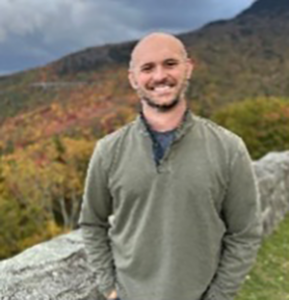
Hunter Ingram is the assistant museum director for the Burgwin-Wright House and Gardens. At the house, he is the host of the award-winning podcast “Burgwin-Wright Presents…” which tells the history of the Cape Fear region through a number of topics including local legends, historic preservation, and the book and TV series “Outlander.” Hunter also hosts river cruises and walking tours in downtown Wilmington for the Burgwin-Wright House. Previously, he spent more than seven years working for the Wilmington Star News and served as the historian for Old Baldy Lighthouse and the Smith Island Museum of History on Bald Head Island.

Stacey Jones is a native and lifelong resident of Wayne County, North Carolina, whose deep roots in the region drive his passion for historical research and battlefield preservation. He holds degrees from Wayne Community College, Mount Olive College, and Campbell University Divinity School, with an academic background in agricultural sciences, business, and religion. Driven by a strong devotion to local genealogy, Civil War history, and American Revolutionary War research, Jones actively helps preserve North Carolina’s historical legacy. He currently serves as the Vice-Chairman and Treasurer for the Save Wyse Fork Battlefield Commission.
Jones began his publishing career with his first self-published book, The Goldsboro Rifles 1859-2009. He contributed research to Wade Sokolosky’s the Carolinas Campaign 1865, Volume 1. Recently, he has authored and published August Reign of Terror: Major James H. Craig’s 1781 Punitive Raid with Dennis Harper, and wrote the Neuse News feature, “Where was Richard Caswell in 1781?”
Currently, Jones is working on a biography of Brig. Gen. William Gaston Lewis entitled Lee’s Last Wounded General for future publication. He is also actively involved in establishing the Eastern North Carolina Revolutionary War Trail while continuing research collaborations for upcoming historical titles authored by Wade Sokolosky.

Dr. Kim Sherman is a historian, writer, and educator from Wilmington, NC. Kim’s research has largely centered around social history in the British Atlantic World and in the Lower Cape Fear, with attention to family networks, Scottish migration, and loyalism. Kim received a PhD in Modern History from the University of St Andrews in 2018. Having worked in higher education for more than fifteen years, she is currently a Lecturer in Atlantic History at the University of North Carolina Wilmington.
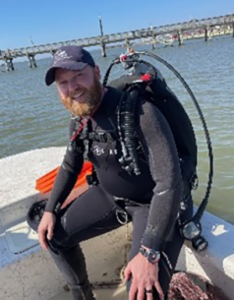
Stephen Atkinson began his career in maritime archaeology while excavating and conserving artifacts from the Emanuel Point Two Shipwreck. While there in Pensacola, FL, he also participated in locating, mapping, and excavating numerous other wrecks from the 16th to 20th centuries, from ships of discovery to the sidewheel steamers of the industrial age. He has worked on various land projects as well, from Roman forts in northern England to prehistoric caves and historic cemeteries in Florida and Alabama.
After serving as an archaeology intern at the Warren Lasch Conservation Center in 2016 digitally recording the H.L. Hunley, Stephen’s career with OSA began at the Queen Anne’s Revenge Conservation Lab, where he served as a conservator. He then transferred to the Underwater Archaeology Branch (UAB) in Kure Beach to become an Assistant State Archaeologist in the fall of 2019. Stephen was promoted to Deputy State Archaeologist-Underwater in 2024 and is now responsible for all UAB operations. Since then, he has orchestrated the recovery of prehistoric dugout canoes, the recovery of what may be the 1748 wreck of La Fortuna and participated in global archaeology projects at the Sunken City of Port Royal, Jamaica.
Field University Program Pricing
Friday Walking Tour of Moores Creek NMP with Dr. Fonvielle $25
(Bring your own lunch; bottled water will be provided)
Saturday Symposium Day $25
Students are free for the symposium.
(Bring your own lunch; bottled water will be provided)
Registration
2027-2-19-Revolutionary War Lower Cape Fear River
Please bring your lunch; bottled water will be provided.
Complete your registration by filling out the form below and making your secure payment.
To register by mail or fax, download: Printable Registration Form
Questions? Need more information? Please Contact Us